Content & Graphic Design
Question: Which Video Preparation Method Works Best for Most Lawyers?
By Jonathan Spencer | 06.23.2026
Video has become the content currency of the legal profession. Clients expect it. LinkedIn rewards it. Referral sources notice when a lawyer shows up consistently in their feed with something worth watching. Most attorneys know this. Most lawyers want to try it.
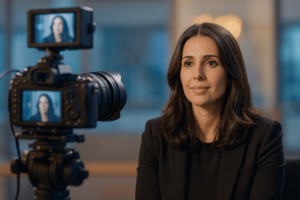 But here’s the part nobody talks about enough: just because an attorney can deliver a knockout courtroom argument or walk a corporate board through a complex transaction without breaking a sweat doesn’t mean they won’t freeze when the red recording light goes on. That reaction is nearly universal among lawyers who are new to video, and it has nothing to do with intelligence, confidence, or communication skill. It has to do with preparation: specifically, the wrong kind.
There are essentially three ways attorneys prepare for video. Each has a different skill requirement and a different failure mode. Knowing which one fits you is worth more than any production tip.
Why the Teleprompter Attracts Smart People
The appeal is easy to understand. A fully written script scrolls at eye level behind the lens. You control every word, leave nothing to chance. For lawyers who live by precision, this sounds like the professional move.
It can work. News anchors and polished executives use teleprompters effectively. But what they share is hundreds of hours of practice reading from one, because the challenge isn’t accuracy: it’s making the delivery look effortless despite the mechanism behind it.
Without that practice, what viewers pick up on is a subtle scanning movement in the eyes, a face that goes flat, a cadence that doesn’t match how people actually talk. Teleprompter Pro points to monotone delivery as the primary way a prompter-read script sounds robotic, and video already compresses energy and expression before you add the mechanism. A teleprompter can amplify both problems if you haven’t put in the reps.
If you’re practiced on a prompter, it’s a clean and efficient format. If you’re reaching for it because it feels controlled rather than because you’ve earned it, it may be working against you more than you realize.
The Case for Bullet Points
Most attorneys who move away from a full script land here: a few key points outlined, delivered conversationally. It’s a real upgrade.
The reading problem disappears. Your face stays animated. The delivery sounds like a person talking rather than text being vocalized. In our experience working with lawyers, they tend to structure their thinking from point A to point B to point C with more discipline than most professionals. That structure is already built in, which gives bullet-point prep a natural fit.
This works well for attorneys who are already comfortable speaking extemporaneously: the ones who handle pitches, panel appearances, and client briefings without much anxiety. An outline gives just enough scaffolding without getting in the way.
The ceiling shows up when you’re not already at ease off-the-cuff. Drift, over-explanation, and losing the thread mid-outline are real risks. Bullet points are better than a script you can’t deliver naturally, but they still ask something of the speaker.
The Format Most Lawyers Skip
Here’s the one worth paying attention to: someone asks you a question off camera, you look at the lens and answer it.
That’s the whole format.
Q&A video (where a colleague or staff member poses a question from behind the camera and the lawyer responds directly) is consistently underused in law firm content. Which is odd, because it’s the format attorneys are most trained to perform.
Think about what the job already asks of you. Depositions. Oral arguments. Strategy calls where a client is pressing you hard. New business pitches where the prospect is poking at your answers. High-pressure, question-and-answer situations are the job description. A question on camera is the same cognitive task at considerably lower stakes.
The mechanism matters. When a lawyer stands alone in front of a camera and ‘presents,’ they’re in performance mode. When someone asks them a question and they respond, they’re in a mode they’ve been practicing for years. This is why attorneys who look stiff in solo talking-head videos often come alive in podcast recordings and panel discussions. It’s not the format, it’s the frame.
The American Bar Association reports that only 28% of law firms currently use video for marketing. The barrier is rarely a shortage of things to say. It’s discomfort with delivery. Q&A removes most of that friction.
One camera. One person off-screen with a prepared question. Sixty to ninety seconds of response. No prompter, no memorized script, no outline to lose. In our work with law firms, we recommend this format above all others for lawyers who are new to video, because it does something the other approaches can’t: it lets clients see and hear the person behind the practice, not a polished but anonymous presenter.
None of the three formats is universally right. If you’re practiced on a prompter, use it. If you’re a natural extemporaneous speaker, bullet points will serve you well. But if video keeps getting pushed to next quarter because you’re not sure how to show up, try the format where someone asks you a question.
You already know how to answer one.